Exposed vs Concealed Ductwork: Which Suits Your Project?
Exposed ducts give restaurants and cafés a modern character, while concealed ducts keep ceilings clean in offices and homes. They differ in cost, insulation, noise and maintenance. Here is what to consider before you decide.
5 min read
The basic difference
Ductwork is the network that carries conditioned air from the AC unit to the rooms and brings return air back. With concealed ducts, this network runs above a suspended ceiling or inside dedicated voids, so only the supply diffusers and return grilles are visible. With exposed ducts, the ductwork stays visible below the structural ceiling and becomes part of the interior design.
Both options are technically sound when properly designed and installed. The choice depends on the nature and visual identity of the project, the ceiling height, the budget, and maintenance and cleaning requirements. It is best to settle this at the design stage, before ceilings and finishes are built, because changing course later is costly.
Appearance and the type of project
Exposed ductwork suits restaurants, cafés, showrooms and spaces with an industrial or contemporary style, where visible ducts and pipes add a deliberate design touch and create a sense of height and openness. It also suits warehouses, gyms and high-ceilinged spaces that do not need a suspended ceiling. It does, however, demand tidy workmanship, since every joint, hanger and route is on show to visitors.
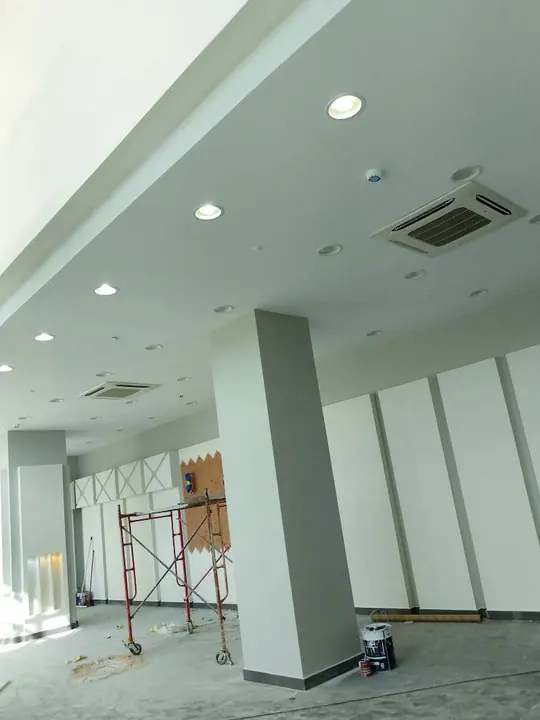
Concealed ductwork is the usual choice for offices, clinics, homes, villas and hotels, where the priority is a clean, visually calm ceiling, with more freedom to integrate lighting and gypsum features.
Some projects combine both approaches, with exposed ducts in the dining area or showroom floor to highlight the architecture, and concealed ducts in offices, washrooms and back-of-house areas. This approach needs careful coordination where one style meets the other.
Cost, finishing and insulation
Exposed ducts are not always the cheaper option. They may save the cost of a suspended ceiling, but they require higher-quality fabrication and finishing, neat joints and supports, painting, and careful route coordination. Concealed ducts, on the other hand, need a suspended ceiling and access panels, but the ductwork itself does not need a fine visible finish because it is out of sight. It is therefore better to compare the full cost of each option, including ceiling, finishing and insulation, rather than the price of the ductwork alone.
Insulation is essential in both cases. When cold air runs through a metal duct, moisture can condense on its outer surface if the surrounding air is warm and humid enough, and the drips can damage ceilings and finishes. Insulation also limits the heat the cool air picks up on its way to the rooms. Concealed ducts are therefore usually wrapped in external insulation with a vapour barrier, especially where they pass through hot voids under the roof. Exposed ducts can be insulated externally and covered with a suitable finish, or built as double-wall ducts with insulation between the walls to keep a clean metal look; the designer chooses the solution based on site conditions.
Noise, maintenance and ceiling height
With concealed ducts, the suspended ceiling helps absorb some of the sound, while airflow noise can be more noticeable with exposed ducts, especially in spaces with hard surfaces that reflect sound. This is managed by designing suitable air velocities, choosing good diffusers, and using acoustic lining or flexible connectors where needed.
For maintenance, exposed ducts are easy to inspect and reach, but their outer surface collects dust and needs periodic cleaning to keep looking good. Concealed ducts need access panels in well-planned locations to reach units and dampers. In both cases, the inside of the ducts may need cleaning from time to time, especially in dusty locations. As for height, concealed ducts need enough void above the suspended ceiling, which reduces the clear height of the space, while exposed ducts need no suspended ceiling, so most of the height remains available, an important advantage in shops with low ceilings.
Round or rectangular, and coordinating with other services
Round ducts, usually spiral, offer smooth airflow, lower resistance and less leakage at the joints, and they look attractive when exposed, which is why they are common in restaurants and cafés. Branches and changes of direction use ready-made fittings, giving a tidy look when the layout is well planned. However, they need more height to carry the same volume of air. Rectangular ducts can be made shallower to fit tight ceiling voids, which is why they are widely used in concealed systems.
Either way, duct routes must be coordinated with lighting, fire sprinklers, cable trays, cameras, speakers and other services before installation, and this coordination matters even more with exposed ducts because everything is on view. It is also worth remembering that commercial kitchen exhaust ducts are a separate system with their own material and installation requirements, and should not be treated like ordinary AC ductwork.
Colours and finishes for exposed ducts
If you choose exposed ductwork, the finish is part of the design, not a minor detail. It is best to agree on colour and finish with the interior designer before fabrication, since some painting work is easier and better done before installation, and the duct colour should work with the lighting, ceiling and other materials in the space.
Common options and considerations include:
Leaving galvanised steel in its natural metallic finish for a clear industrial look.
Painting the ducts the same colour as the ceiling, such as black or dark grey, so they blend in.
Painting them a standout colour, such as gold or copper, to turn the ductwork into a feature.
Using primers and paints suited to galvanised surfaces so the paint adheres and does not peel over time.
Choosing diffusers and hangers that match the colour and overall finish of the space.
Key takeaway
Exposed ducts give a modern character and preserve ceiling height but demand careful workmanship and finishing, while concealed ducts deliver a clean, calm ceiling but need enough void and access panels. In both cases, good design and correct insulation are the foundation. The Rukn Al Khaleej team is happy to fabricate and install concealed, exposed and round ductwork to suit your project.