How to Choose the Right AC System for Your Building: A Practical Comparison
Wall split, cassette, ducted split, package unit or VRF? A practical guide to where each system fits, from a single room to a whole building, the questions to ask before buying, and why a site survey comes first.
5 min read
Understand your needs before comparing types
There is no single AC type that is best for every situation. What suits a bedroom in an apartment is very different from what a restaurant, a showroom or a full office floor needs. The right choice starts with the space and how it is used, and only then comes the comparison of system types and capacities. In a city like Riyadh, with long, hot summers and dust in many seasons, this decision shapes comfort, electricity bills and maintenance costs for years.
Before you ask for quotations, answer these questions clearly. They narrow down the suitable options and rule out the rest:
Do you need to cool one room, several separate rooms, or a whole floor or hall?
Is the building residential or commercial, and how many hours a day will the AC run?
Is there a suspended ceiling or enough ceiling void to run ducts or hide indoor units?
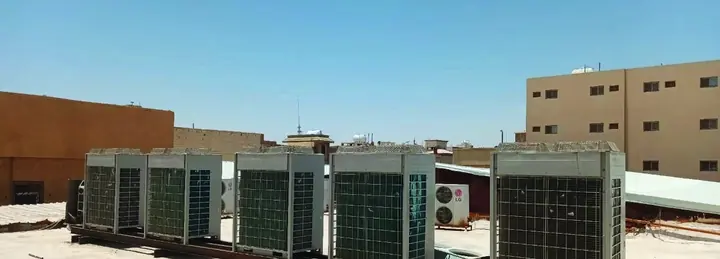
Where can the outdoor units go: on the roof, on the facade or in a light well? Is there enough space around them for airflow?
How important are interior appearance and quiet operation in this space?
Do you need independent temperature control for each room or zone?
What is your installation budget, and how much do long-term running costs matter to you?
Wall split and window units: practical for individual rooms
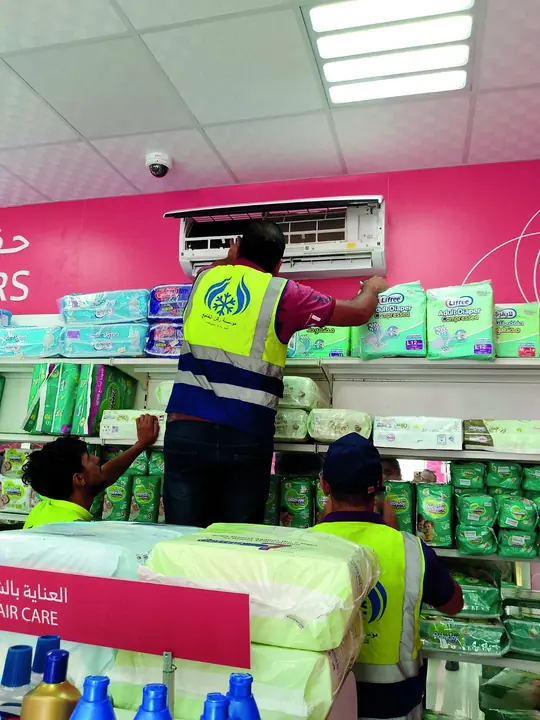
The wall split is the most common choice for homes, apartments and small offices. It has an indoor unit on the wall and an outdoor unit, connected by copper refrigerant lines and electrical wiring, with a condensate drain from the indoor unit. It is relatively quiet inside the room, straightforward to install and service, and widely available in inverter models that help cut consumption. The drawback is that each room usually needs its own unit, so the number of outdoor units on the facade or roof grows quickly.
A window unit packs all its components into one body fitted into a wall opening, so its upfront cost is low, installation is simple and replacement is quick. However, it is usually noisier inside the room, less energy-efficient than a modern split, less flexible in appearance, and needs a suitable opening in an external wall. It remains a practical option for annexes, small storerooms and rooms where running copper refrigerant lines is difficult.
Cassette and concealed ducted split: better distribution, cleaner look
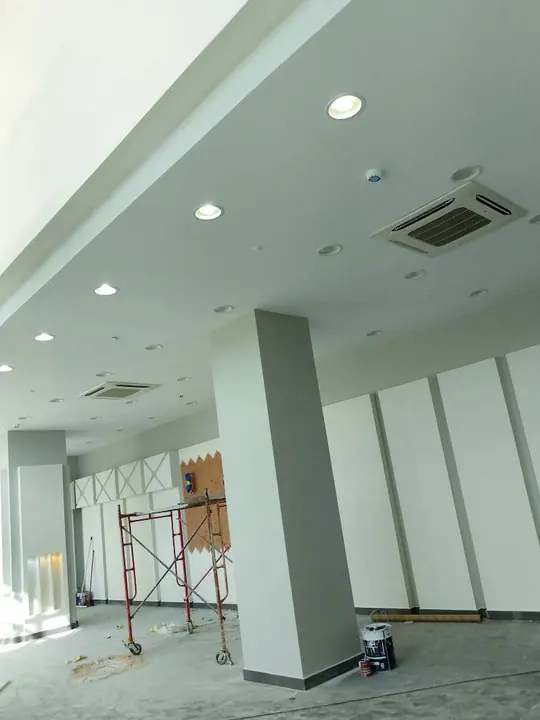
A cassette unit sits inside the suspended ceiling and throws air in several directions, which makes it well suited to showrooms, shops, clinics and open halls that need even distribution without using wall space. It needs a suspended ceiling with enough depth, and the layout should allow easy access to the unit and its drain line for maintenance. It is also important to position the unit so that cold air does not blow directly onto seated staff or customers.
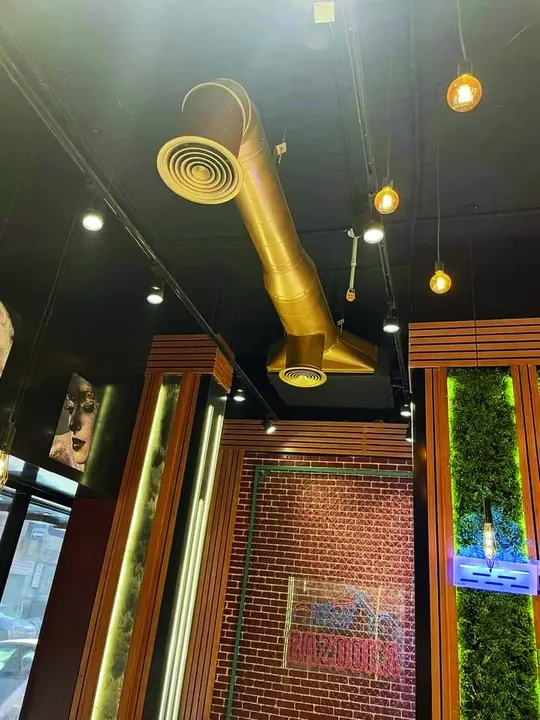
With a concealed ducted split, the indoor unit is installed above the suspended ceiling and air reaches the rooms through ductwork, supply diffusers and return grilles. It gives a clean finish and quiet operation, suits villas, offices, halls and restaurants, and one unit can serve several adjoining spaces. In return, it needs enough height above the ceiling, careful sizing and insulation of the ductwork, and well-placed access panels, because any design mistake shows up directly as uneven airflow and noise.
Package units and VRF: solutions for larger and commercial buildings
Package units combine the cooling components in one large unit, usually installed on the roof or on the ground outside the building, with air distributed through a duct network. They suit large spaces such as showrooms, halls, air-conditioned warehouses and big retail stores, and they are convenient to maintain because most of the work happens outside the occupied space. They do, however, need a suitable location (if roof-mounted, the roof must be able to carry their weight) and suitable routes to bring the ducts into the building. They can work with either concealed or exposed ductwork, depending on the interior design.
VRF systems (also known by the trade name VRV) connect several indoor units to a shared outdoor system, with independent control for each zone. They are a strong option for large villas, office buildings, hotels and multi-room clinics, especially where you want fewer outdoor units and good efficiency at part load. Upfront cost is higher, and they need precise design and installation by a specialist team.
The common choices can be summarised as follows, although the site survey is what settles the decision:
One room on a limited budget: wall split or window unit.
Shop or showroom with a suspended ceiling: cassette or concealed ducted split.
Villa or office where looks and quiet matter: concealed ducted split or VRF.
Large open space with available roof area: package unit with ductwork.
Multi-room building needing independent control in each zone: VRF.
Why a site survey and load assessment come before buying
Choosing the right capacity matters as much as choosing the type. An undersized unit runs for long hours without reaching the desired temperature, while an oversized one switches on and off frequently, removes humidity poorly, wastes energy and puts more strain on its components. That is why floor area alone is not enough: orientation, glazing, insulation quality, number of occupants, equipment, lighting and the nature of the activity all affect the cooling load.
A site survey also reveals constraints that do not appear on drawings: the depth of the ceiling void, routes for copper and drain lines, outdoor unit locations and the capacity of the electrical supply. When comparing offers, ask how the capacity was calculated, which unit types are proposed, how piping and insulation will be done, and what the maintenance plan is after installation, rather than comparing on price alone.
Remember that the cost of a system is not just the purchase and installation price. Running costs over years of use, ease of access for maintenance, and the availability of spare parts and service all deserve a place in the comparison. The system that is cheapest to buy can end up the most expensive if it consumes a lot or is hard to maintain.
Key takeaway
The right system is the one that fits the space, how it is used and the constraints of the building, not simply the cheapest or best-known. Define your needs first, and ask for a site survey and load assessment before buying. The Rukn Al Khaleej team is happy to help you choose, supply and install the right system.